
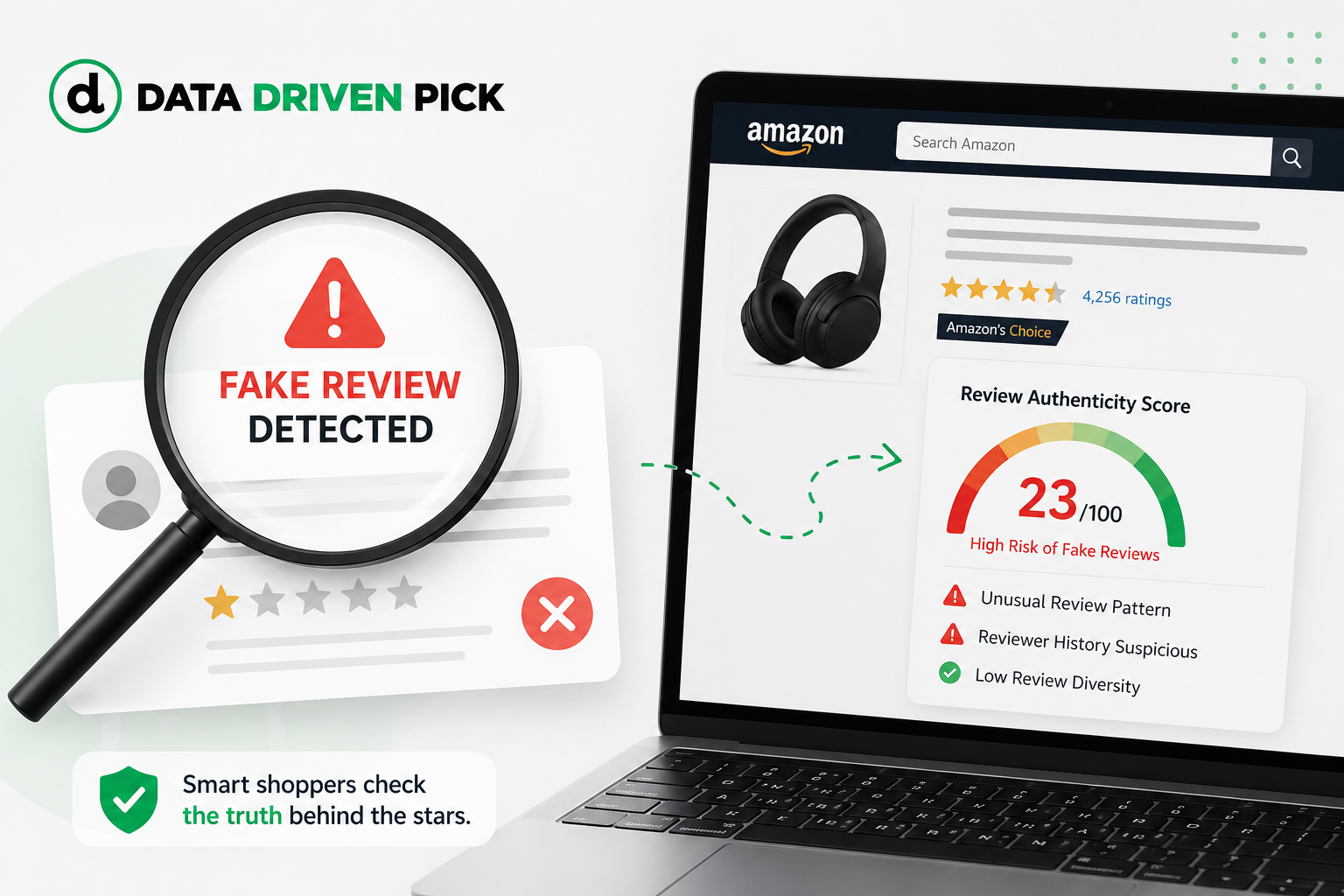
Most advice on this is out of date, so the important part first: the two tools everyone still recommends are gone.
Fakespot shut down on July 1, 2025. Mozilla had bought it two years earlier, then pulled the extension, the apps and the website, and switched off the Firefox Review Checker three weeks before that. ReviewMeta went dark in early 2026 without even a goodbye post. Between them they had something like ten million users, and nobody filled the hole.
Articles published this year still list both as top picks. If that's the advice you've been going on, you've been relying on software that doesn't exist anymore.
So what's left? A few free tools that still work, plus some checks you can do yourself that nobody can take away from you.
Free tools that are still running
Browser extensions. Several free Chrome extensions grade an Amazon listing while you shop, usually with a letter score and an "adjusted rating" that throws out the reviews their algorithm doesn't believe. Most cover the international domains too. Check two things before installing one: whether the analysis runs on your machine or gets shipped to someone's server, and what permissions it wants. A review checker has no business reading every site you visit.
Paste the link websites. If you'd rather not install anything, a few sites let you drop in an Amazon URL and get a read back. Slower, but nothing sits in your browser and you hand over no permissions.
Keepa and CamelCamelCamel. Neither is a review checker, which is exactly why they're worth having. They track price history, and Keepa logs when a listing's title and images change. If a page was selling phone cases in March and kitchen scales now, the reviews on it were earned by something else.
One warning. Most of the current crop are side projects with no real income behind them, which is roughly how Fakespot and ReviewMeta ended up. Don't get attached to any one of them, and treat whatever grade you get as an opinion rather than a verdict.
Five checks that cost nothing
These take about a minute, and they work whether or not you've installed anything.
Look at the shape of the ratings, not the average. A real product with a lot of buyers gives you a slope: plenty of fives, fewer fours, a scattering of threes and twos, a thin tail of ones. Manipulated listings tend to look different. You get a wall of fives, almost nothing in the middle, then a cluster of furious one star reviews from people who actually bought the thing. That hollow middle is the giveaway.
Sort by most recent. "Most helpful" is easy to game with vote manipulation, and it has a habit of showing reviews from three years ago. Recent ones tell you what's in the box today, which matters because manufacturers swap suppliers and change components without touching the listing.
Check that the reviews are actually about what you're buying. This is the one that catches the most, and hardly anyone does it. Scroll until you find reviews describing something else: a color that isn't offered, a size that doesn't exist, a completely different category of product. Sellers merge unrelated items into one variation family, or take over a dead listing and repurpose it. The reviews are real people. They just belong to a different product.
Search a suspicious sentence in quotes. Take an oddly specific line out of a glowing review, put it into Google inside quotation marks, and see what comes back. If the same sentence shows up under four other products, you've found a template.
Don't put much weight on "Verified Purchase". All it proves is that somebody paid. Paid reviewers buy the product, get their money back off platform, and post a verified five star review like anyone else. Click through to the profile instead. An account whose whole history is five star reviews posted inside two weeks isn't a shopper.
If a listing fails two of these, I'd move on. There's almost always something else in the category that doesn't.
Where we come into it
Running those checks on one product is easy enough. Running them across a whole category, forty or fifty listings and a few thousand reviews, isn't something you'll realistically do on a Tuesday night.
That's the gap we work in. We don't buy and test every product ourselves, and we won't pretend we do. What we do is work through the reviews real buyers have already written, at a volume you can't reach by hand. Those people spent their own money, lived with the product for months, and wrote down what went wrong. That's useful evidence. It's also sitting in a pile of noise, some of it invented.
So we pull the full review set for a category and run the same checks across all of it: distribution shape, timing clusters, repeated phrasing, reviews that don't match the listing, reviewer accounts that don't look real. Anything that doesn't hold up gets dropped, and the ranking is built from what's left. Filtered real buyer experience, instead of whichever seller bought the most reviews.
Two things you're owed in return. Our method is written up and linked, so you can see what got cut and why. And we earn a commission if you buy through our links, which has no bearing on the order. If the product at number one pays us less than the one at number four, so be it.
The one minute version
Check the ratings for a hollow middle. Sort by recent. Scan for reviews that belong to a different product. Look the listing up on Keepa. Add an extension if you want a second opinion, but make the call yourself.
None of that depends on a tool being around next year, which after the last two years is rather the point.